The Neighborhood
Watercolor and Ink 12" x 18"
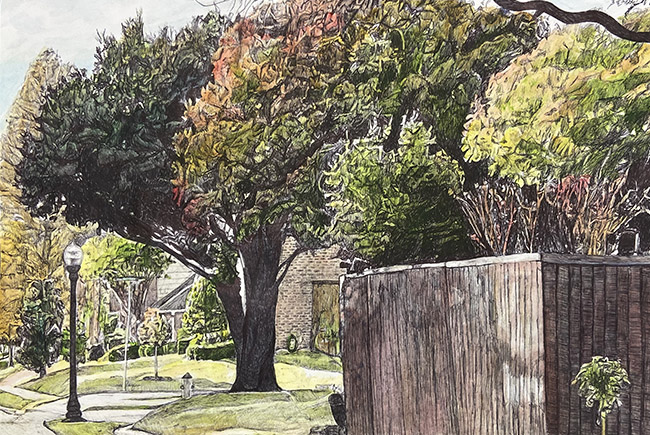
Hannah Xu attended Jasper High School in Plano, Texas, and this piece of hers first appeared inVoicesin 2022.
The Rich Kid's Room
Charles Merkel
The treasure was literally a ’50’s kid’s heaven. Everything we worked on—every
hobby, every collection—was in this one bedroom. Not all of our possessions combined
could’ve touched the display’s completeness or the astounding condition of the items. I
could only wonder what pride such a trove must’ve evoked.

A complete set of Hardy Boys books stood neatly on the top shelf of an oaken
bookcase. Their beige covers with the brown silhouette of Frank and Joe were caressed
by the books’ colorful jackets. On the bottom shelf sat five cigar boxes, each containing a
different year of Topp’s baseball cards. Every AMT model car from ’58 and ’59,
flawlessly spray painted, sat parked on the two middle shelves.

Across the room a matching bookcase held a nearly complete American coin collection
from 1856 to present. Hundreds of coins were pressed into slotted blue folding booklets,
like we all had, but which were, in our case, mostly empty holes. Unlike Eddie and me,
who visited the dumpsters behind the businesses in the industrial park and tore cancelled
stamps from letters and later soaked them off, the stamp album we gazed upon here was
nearly complete with hundreds of U.S. commemoratives, all unused. Model ships, Lionel
train sets, and model planes lined other shelves. Even stuff that came in cereal boxes
like plastic frogmen and soldiers from Kellogg’s, or small tin state flags from Nabisco,
was there.  Every last one of them.

Surprised at being asked to perform a somber task, we were in Russ Pemberton’s room. Grace
Pemberton had seen Eddie and me throwing a baseball in the dusty field behind their property,
the field where we all played baseball every summer day, seemingly all day, stopping only
on the days we had Little League practice.

“I wonder if you boys might help me this morning. I saw you were here early and I thought
maybe your friends could get by without you for a couple of hours,” she had said somewhat
shakily. Having rarely seen her up close before, I noticed how pretty she was despite her
grimness.

“As you may know we’re moving today and, oh my,” she exhaled, “I thought you might box up
the things up in Russell’s room for me. It’s too difficult a task for a mom. I’ll pay you
ten dollars each.”

Ten bucks?  For maybe an hour’s work?  It was a fortune to an eleven-year-old in 1959.
“Yes, ma’am,” I replied without checking with Eddie. “We’ll help.”

Russell had passed away a month before. He too had been eleven. We had attended his funeral,
but hadn’t known him. He had been a sickly kid born with hemophilia and defective kidneys.
When he was five, he contracted polio. The Permbertons had moved to Louisville six years
before. Russ couldn’t go to school; he had tutors. He always seemed to have pneumonia or
hepatitis whenever we heard anything of him. When we played baseball we would frequently
look up and see him sitting at his window. After what seemed like several summers, I
began to wave each day, a gesture he seemed only too anxious to return.

We never saw him at the shopping center, or at any games, or even in church. Yet we always
thought because the Pembertons—living in the storied house on the hill at the end of Gheens
and Cumberland Streets—were rich, while the rest of us barely cracked the middle class,
that Russell was some sort of prince gazing down at us. Perhaps, I had allowed myself, he
sat scrutinizing, making mental notes of our silly faults and stained clothes, and tracking
our endless mistakes on the diamond.

As I examined the complete set of Big Ten and SEC pennants Russ had hung in rows on his slate
blue walls, I blurted, “Geez, Edward, what a deal, old Russell here had everything.”

“Talk about a silver spoon in your mouth.” Eddie agreed.

“Man,” I went on smirking, “no wonder he never came out, ‘R. Pemberton,’ the richest kid in
the world. The pampered boy-king of Kentucky.”

Panic abruptly seized me as I realized my words had been overheard. Mrs. Pemberton walked in
trembling like she might collapse. I had been slapped before, by my dad and a couple of
teachers, and I prepared to take a good shot. Of course, nothing that easy happened.

She stopped, her eyes full of tears, less than arm’s length from me. Indoors, I became
instantly aware of her femininity, perfect clothing and delicate scent. For the first time,
I realized she was suffering terribly, and I felt awful about how badly I must’ve hurt her
on top of how bad she was already hurting. Her jaw quivered but she managed not to break
down. Whatever angst she had felt seemingly waned enough for her to speak wistfully but
without wrath.

“I am going to tell you boys something. My sweet Russell was a wonderful son. I guess
Blake and I like to think he was as happy as he could be, given the circumstances. But you
absolutely must understand he really had so. . . little.”  I nodded, feeling as guilty as
I possibly could and not even faintly clinging to a single tenet of the idiot observation
I had just vocalized. “These things you’re packing,” she continued, “might have given him
some comfort, some distraction, but to him you were the richest kids in the world.

“I can tell you, Charlie”—it never dawned on me that she knew my name—"that there was
nothing he wanted more than to be like you. Not to sit here watching from this museum,
this prison, but to have his shirt soaked in sweat, and the knees long torn out of his
pants. To carry a worn-out glove and a broken bat nailed together and taped. To daringly
yell forbidden words when the ball got past him. Just . . . ” her voice cracked, “just to
be one of you.

“So I ask you to . . . try to understand, to be respectful about what he went through.
And because it was all he ever wanted, to give him some credit for his desires and his
judgment. And to be thankful, thankful to God for the beautiful life He has given you.”

I noticed that Eddie had begun to sob which was some solace because tears were already
streaking my dust-caked face.

Then she too began to cry, and she took us both in her slender arms, this elegant,
beautiful lady that we used to make fun of, and we all held one another for a time.

“I’m so sorry, Mrs. Pemberton,” I finally managed, feeling rotten not only about my
comments but by the fact that none of us had ever visited Russell.

“It’s okay,” she said nearly whispering. “We all say things we don’t think about
beforehand, just try to remember that you—that we, have the terrible power to wound
others with our words.

Later, we sat in her kitchen having lemonade. I began to feel like I could almost love
this person. “Perspective is everything,” she said softly and with the faintest smile,
“I imagine you boys will remember this day for a long time.”

“Yes ma’am,” I answered respectfully, having no idea just how hauntingly accurate her
words would prove to be.